Shoofra — Window Display Collaboration
1. The unresolved moment
A storefront window has seconds to speak.
Not minutes.
Not explanations.
It has to interrupt movement on the street — without shouting. To invite curiosity without promising too much. The tension here wasn’t how to decorate a window, but how to create a pause in the flow of the city.
This wasn’t about showcasing products.
It was about whether a passerby would stop — even briefly — and feel something shift.
2. The constraint
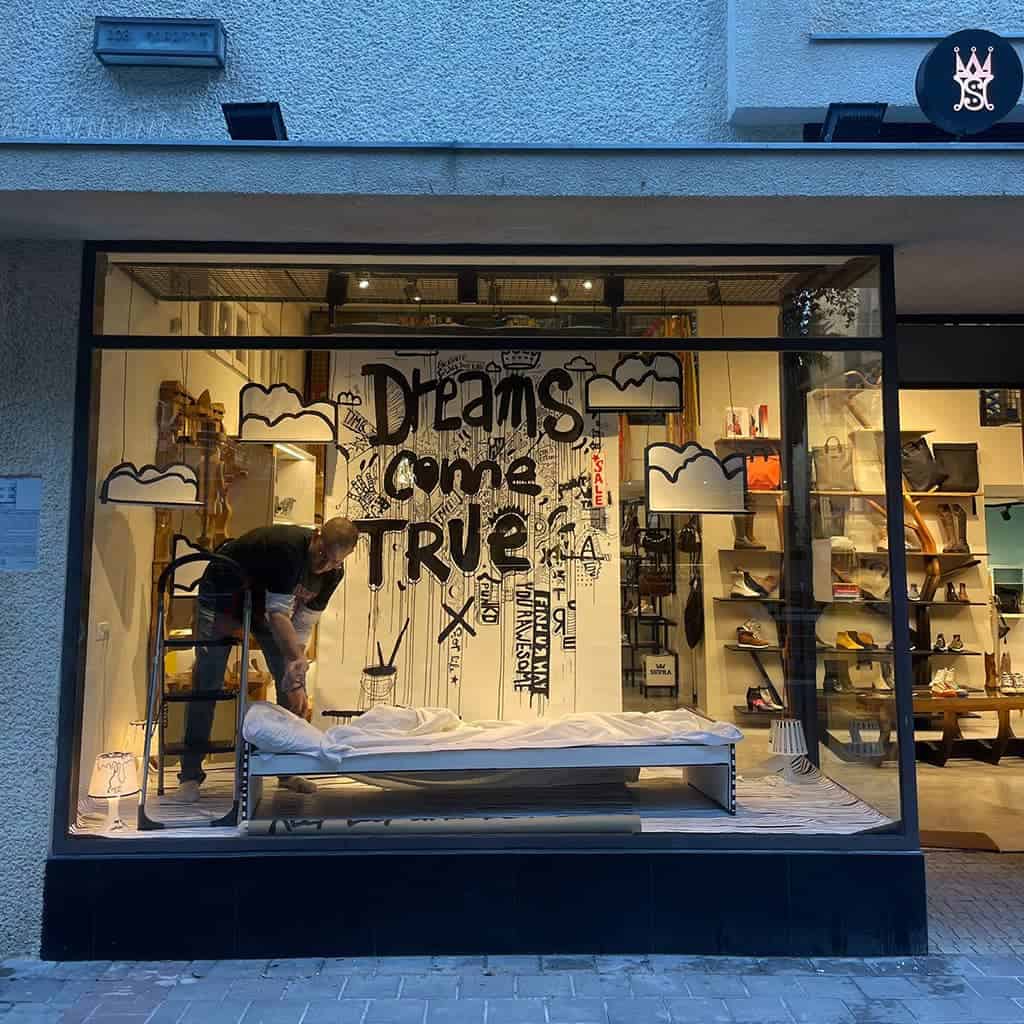
The work existed inside a single window at Dizengoff 108.
Limited depth.
Public visibility.
Constant movement outside.
The installation had to function day and night, during sales season, with real products that could not be abstracted away. Decisions had to remain flexible — some made on site, in real time.
This wasn’t a controlled environment.
It was live.
3. The decision
The project narrowed to one decision:
Let the window speak in outlines — and let the product carry the color.
The visual language became intentionally reduced: black-and-white contour lines forming a dreamlike, open scene. The shoes remained the only elements carrying color — personal, varied, human.
Meaning would come from contrast, not complexity.
4. The reasoning
The obvious alternative was spectacle:
bold props, heavy set design, a visually crowded scene competing for attention.
That approach was rejected.
A window doesn’t need more information.
It needs clarity.
By stripping the environment down to graphic contours, the display created space for projection. The colorfulness wasn’t imposed — it arrived through the shoes, and through the viewer’s imagination. Even last-minute decisions — whether to add objects, gestures, or signatures — were treated as part of the process, not disruptions to it.
The window stayed open — conceptually and practically.
5. Reflection
Public-facing work doesn’t belong to the artist alone.
It belongs to the street.
When a display allows people to see themselves inside it — without explanation — it stops selling and starts communicating. Not loudly. Just clearly enough to be felt at eye level.
This window didn’t promise dreams.
It made space for them.