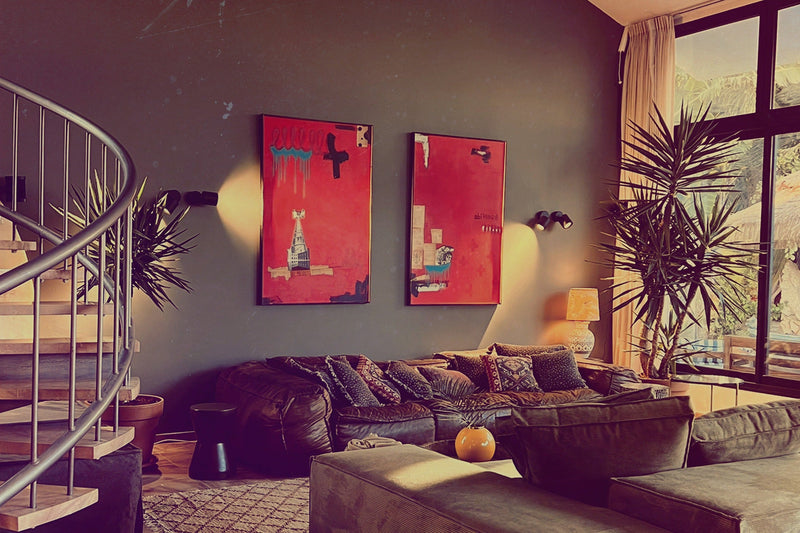
UNFRAMED — THE HONEST CHOICE

1. THE UNRESOLVED MOMENT
There's a version of this that everyone knows:
the framed print that arrived looking important, got hung, and slowly started to feel like it was trying too hard.
The frame announced itself. The art receded.
The wall looked finished. Nothing felt right.
Unframed prints solve a problem most people don't realise they have.
2. WHY UNFRAMED WORKS
A print without a frame makes a different kind of claim. It says: the work is enough. It doesn't need a border to tell you where to look.
For walls that breathe — high ceilings, open spaces, industrial interiors — unframed prints sit more naturally. They don't compete with the architecture. They become part of it.
For renters, it's also practical. Unframed prints roll. They travel. They survive three moves and still look exactly the same.
3. THE DISPLAYS THAT WORK
Hanging with clips or rails. Architectural hardware, or simple metal clips — the print hangs clean, the mechanism is visible and honest about what it is.
Leaning. Against a shelf, a ledge, the floor. This is the least committed and often the most confident. It says the piece belongs in the room without needing to prove it.
Grid arrangements. Multiple unframed prints on a single wall, evenly spaced. No frames means nothing interrupts the composition across pieces. The collection reads as one thing.
4. WHEN TO FRAME
Some pieces need a frame. Works on delicate paper, prints with significant white borders, anything going into a humid room — framing protects them and extends their life.
The question isn't framed vs. unframed as a philosophy.
It's what serves this particular piece on this particular wall.
5. THE RESULT
Unframed isn't the budget choice or the temporary choice.
It's a specific aesthetic position — one that lets the work lead.
If your room is doing the talking, unframed art listens.
If the art should speak, unframed lets it.
All prints available framed or unframed. 100 limited editions each. yagilweiler.com